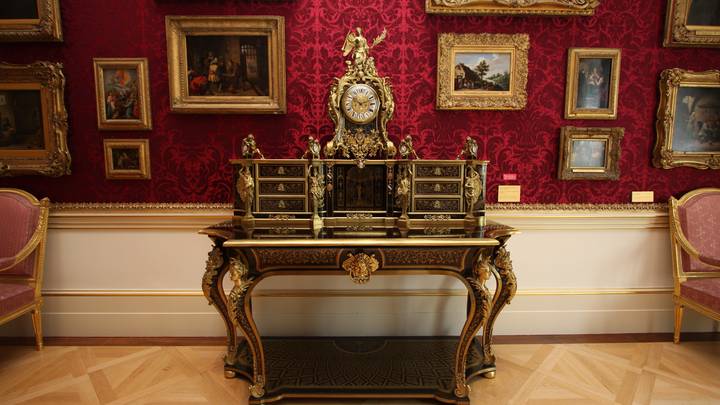
The Wallace Collection contains one of the world’s greatest collections of old master paintings, arms and armour and decorative arts. However, it is also home to an exceptional group of Boulle and Boulle-style furniture. This intricate and luxurious marquetry technique – named after André-Charles Boulle (1642-1732) – enthralled collectors like the 4th Marquess of Hertford (1800–1870) and Sir Richard Wallace (1818–1890), whose dedication to the decorative arts laid the foundation for the museum’s current holdings.
Hertford had a great love of Boulle furniture and sometimes commissioned high-quality copies of pieces he was unable to acquire. A notable example is the Elector of Bavaria’s writing table, he ordered two copies in 1857 at a cost of £1,650.
To place this in context, a year earlier, he paid £4,550 for The Rainbow Landscape by Peter Paul Rubens (1577–1640). This emphasises how highly he valued fine furniture, even relative to major paintings, a point made by Peter Hughes in the Wallace Collection Catalogue of Furniture in 1996.
Between 1853 and 1857, he commissioned at least seven reproductions, the most expensive being a copy of Riesener’s jewel cabinet for the comtesse de Provence, now in the Royal Collection, at £2,500. These were not forgeries, but legitimate copies, and no efforts were made to disguise that.
When the Wallace Collection opened to the public on 25 June 1900, attention quickly turned to the physical condition of its contents. Even before the public unveiling, extensive restoration work had been carried out. The first entry in the Register of Repairs and Restorations in 1898 notes ‘general skilled cleaning by Audre of Paris’ at a cost of £800.
Boulle furniture, by its nature, presents unique conservation challenges. Constructed from a complex combination of materials, such as brass, turtleshell and various woods, its intricate marquetry is vulnerable to environmental changes, especially humidity fluctuations.
By 1910, much of the Boulle work at Hertford House had deteriorated significantly. A 1917 memorandum explicitly stated that ‘about three quarters of the repairing and cleaning done at Hertford House comes under this heading’. Boulle marquetry pieces were losing their inlays at an alarming rate. The fragility of Boulle furniture led to the employment of a full-time furniture repairer in 1913 and eventually to the development of formal training programmes.
In the subsequent decades, the vast majority of furniture underwent treatment at least once. By the mid-20th century, furniture treatments became increasingly sophisticated and were recorded in greater detail, though many would still not meet today's standards. Historically, strong alkalis were used for cleaning, shellac was applied to mounts for protection and abrasive powders were used to clean marquetry.
As the understanding of conservation advanced, the Wallace Collection’s practices evolved accordingly. For example, in 1957, the position of ‘Repairer’ was replaced by that of ‘Conservation Officer’, and by the 1970s, a modern conservation department was established.
This shift marked the beginning of more analytical, evidence-based approach. Techniques such as micro-sampling, cross-section microscopy, infrared and ultraviolet imaging, dendrochronology and X-ray fluorescence (XRF) became more widely used.
In 2007, the Wallace Collection acquired a handheld XRF analyser for non-invasive analysis. Tools such as these have enabled us to better understand the composition of materials without intervention and to ensure the most appropriate treatments are carried out.
Conservation materials and techniques have evolved over time, with the aim of using the least invasive and toxic treatments. To clean mounts, EDTA can be applied as a gel or on poultices to clean gilt-metal mounts, while methylated spirits can be used to remove old shellac, and even dry ice has been used to remove ingrained dust and grime.
Reversibility, or rather re-treatability, and thorough documentation are cornerstones of modern conservation practice, and we consistently adhere to these principles.
Vacuum clamping and traditional Japanese shimbari techniques are also standard practices, and provide controlled means by which to stablise and rejoin delicate components. In addition to traditional materials like gesso and shellac, modern conservators at the Wallace Collection utilise fibreglass mesh and synthetic resins to reinforce structures.
Fillers made with animal glue and bulking agents are used for losses, and mica powders are applied to corroded metal mounts to improve appearance without over-cleaning.
We use ‘like for like’ if beneficial to the object but not out of principle; we use protein glues because these have a proven track record and still fit today's conservation criteria. Modern conservation grade coatings are applied to protect alongside more traditional wax coatings if required.
An important aspect of conserving artworks, particularly Boulle furniture, involves creating stable gallery conditions, but without endangering our own wider environment. To work towards a sustainable future, the Wallace Collection has taken steps to reduce its environmental footprint, including installing solar panels, LED lights, and upgrading HVAC systems.